Saturday, July 26, 2008

Recoleta Pictures


Ok, here's the rundown on the pictures from the Recoleta Cemetary: the first is one of the hundreds of mausoleums in the cemetary, each of them differently designed. The above picture is a testament to Argentina's immigrant past (and frankly, the most hilarious name I've ever seen). Then, a really old mausoleum that has broken in the front so you can peek in and see the actual coffins just inches away...next a view down one of the mausolem-lined pathways. Then another mausoleum, and finally one of the many plaques on the mausoleum of Evita, dedicated by the town of Almirante Brown. Enjoy!


Thursday, July 17, 2008

¡Viva el campo!

Historic happenings in Argentina...so a few months ago the president of Argentina, Cristina Kirchner proposed an agricultural export tax increase to 45%, which caused a huge uproar among the farmers here. They've been protesting/on strike/blocking food transportation for months now, and yesterday the Senate voted on the proposal. In anticipation of the vote, there have been huge demonstrations around Buenos Aires, at least one with over 250,000 people, this past week. Yesterday the Senate debated into the night, and ended up tied 36 to 36, with only Kirchner's VP left to vote...and at 4:30 am today he voted AGAINST the proposal, which is completely unheard of. People have been going nuts - there were a ton of people out in the streets last night banging pots and pans and waving Argentinean flags. Everybody has been telling me that this is a really historic time for Argentina - I guess truly honest politicians are few and far between here. Here's a link to a NY Times article on the situation:
http://www.nytimes.com/2008/07/17/world/americas/17argentina.html?_r=2&hp&oref=slogin&oref=slogin
In other, completely unrelated news, I discovered one of the wierdest places ever a few days ago - the Recoleta Cemetary! It's a huge graveyard in the middle of the city where all of the rich people of Buenos Aires have been buried (and still are!) since the 1800s. But there's no grass or dirt like in a normal cemetary - just tons of narrow paved pathways lined with family mausoleums, most at least 8 feet high and squished together like those tall skinny houses in San Francisco. The place is gigantic, and the pathways crisscross in all directions, making it really easy to get completely lost among all the dead folks.
A lot of the mausoleums have windows in them, and you can look in and see actual coffins stacked atop each other like or (for those who prefer to be underground) creepy narrow staircases going down into darkness. One was broken in the front, and when I looked in I saw a sunken room filled with four stacks of cobwebby coffins, stacked seven high. Adding to the general creepiness are the dozens of cats padding silently down the paths or sitting atop the mausoleums, staring at you as you walk by. We asked our tour guide why there were so many cats there and she said simply "Hay ratones" - "There are rats"
It was so wierd and creepy and a perfect horror-movie setting, especially because we got there right before 6, closing time, so there weren't a lot of people there and the sun was just starting to go down. Definitely one of my top 5 places in Buenos Aires so far! Pictures coming soon, I promise!

Sunday, July 06, 2008

Rainy day in Buenos Aires

It's Sunday night, I haven't touched my homework all weekend, and I have to read a 25-page story for class tomorrow...so naturally I'm wasting time online. Just got back from two days in Uruguay, which were amazing!! Uruguay is just across the river from Argentina, and there's a little town called Colonia just a ferry-ride away from Buenos Aires that's really popular with Argentinean tourists.
Since it's the off-season for tourists (it's winter here), Colonia was pretty sleepy, but really pretty. It's a smallish town that's been passed back and forth between the Spanish and Portuguese at least 10 times over the last 400 years, but finally ended up with the Spanish. Everybody on the street is carrying a thermos of boiling water and a maté bombilla - maté is a really strong tea that's everywhere in Argentina and Uruguay. It's really popular and almost everybody drinks it, but unfortunately it's definitely an acquired taste. In my personal opinion, it's kind of like drinking dirt. Anyway, we spent Friday exploring the town and went out to dinner at El Portón, a restaurant recommended by the owner of the hostel we were staying at. I asked the waiter what the "comida más famosa de Uruguay" (the most famous Uruguayan food), he recommended something called Parillo (or something like that), which is shared between two people. Trusting person that I am, I ordered it, and well...I'll describe it and let you decide for yourself. First, they put potato salad, shredded lettuce and tomato slices on a huge plate. Then they pile french fries on top, then a couple of thin steaks, followed by bacon, a generous covering of melted cheese, and two fried eggs. The whole thing is garnished with green olives and rolled up slices of ham. More or less three heart attacks on a plate. That was the first time I've ever eaten steak, bacon and ham in the same bite...and hopefully the last! A true Uruguayan experience.
The next day we woke up to seventy-degree weather!! Keep in mind it's winter here - it was unbelievable! We found a big playa (beach) that was almost completely deserted, and played all day in the Uruguayan ocean. It was completely unexpected and wonderful.
Hope everybody had a great 4th!! We all sang the Star-Spangled Banner a few times on Friday, but that was about it unfortunately.

Monday, June 30, 2008

Comida and other amazing things about Argentina...

Sorry for not writing more often, but this combination of intense Spanish lit classes and crazy Buenos Aires nightlife (the Argentines I go out with are always surprised to see me yawning at 5 am after 4 hours of dancing) has been keeping me pretty busy. I actually have an oral presentation due tomorrow on three cuentos de horror (horror stories), but feel like procrastinating, so it's blog time!
Life is good here in the Southern hemisphere. I'm finally getting used to the whole kissing strangers on the cheek thing, can find my way home from school without getting too lost, and my Spanish is getting better every day. But my favorite Buenos Aires pasttime so far is going out to eat! I love the food here, and the only reason I haven't been packing on the pounds is because I have a good 2+ mile walk to the train station every day. Some of my favorites are:
-alfajores - I know I touched on these last time, but my brief description didn't do these incredible snacks justice! They are pretty much the national cookie of Argentina, and every kiosco (corner stores that sell drinks, candy, magazines etc) has a staggering array of any variety of alfajor. They come plain, covered in chocolate, coconut or meringue, filled with dulce de leche or chocolate creme, plain or chocolate cookies, one or two layers...etc. I average about 2 a day - they're irresistible!
-of course I couldn't write about Argentinean food without mentioning beef, and it's famous for a reason! It's everywhere, and surprisingly cheap. You can get an excellent steak for about $4 American in an average restaurant, and I'm not one to let that opportunity go by. Amazing.
-ice cream. Due to a huge influx of Italian immigrants in the 19th century, Italian food is everywhere here. Argentine ice cream is really more similar to gelato than American ice cream - it's really thick and creamy and, obviously, delicious. My personal favorite flavor so far is Super Dulce de Leche!
-empanadas, which are sort of like little meat pies with flaky pastry crusts. They come fried or baked, and filled with beef, chicken, vegetables, cheese, etc. Four or five of them makes for a delicious lunch or dinner. We had empanadas for dinner a couple of nights ago, and I tried to make one - it looked kind of sad and crooked next to Vivi's (she's a girl my age from Paraguay who works here), but she is going to teach me the recipe, so I can practice making them in the US!
I'm keeping busy lately with school and wandering around town after my classes are over, discovering new restaurants, panaderias, heladerias and shops with some of the other students in my program. One unfortunate downside to living in India for a year is that now whenever I visit other countries, I'm still in a 35-rupees-equals-one-dollar mode, which means that I'm spending money a little too freely here! I have to remind myself every day that despite the 3-to-1 exchange rate, the peso is not Monopoly money!
Ok, I'm off to analyze some literature - hard enough in English, and quite a struggle in Spanish...

Wednesday, June 25, 2008

Hola!

Hola a todos de Buenos Aires!! I've been here for five days and already love it. Since we're leaving for a boat trip on Rio de la Plata soon, I have to make this short, so I'll just list my favorite things about Argentina so far:

1) My family! My host family is awesome. It consists of my mom Alicia, 23-year-old Agustin, 21-year-old Luli, and 11-year-old Clara. Everybody's really nice and the food is awesome. They all speak English really well, which is good and bad. It's nice when I have to explain something complicated, but I told them that I want to speak Spanish as much as possible. I can already tell that my Spanish is improving, which is awesome!

2) Dulce de leche...mmm. Dulce de leche is an Argentinean version of caramel, but more creamy and absolutely delicious. They put it on everything here - toast, waffles, croissants, and alfajores, which are two cookies with a thick layer of dulce de leche in the middle. I'm addicted.

3) Cafes! There are cafes on every corner here, where portenos (the name for residents of Buenos Aires) meet up and sit for hours conversing over a cup of coffee and a couple of medialunas (croissants). Most of the cafes are fairly old and have a great atmosphere. On Sunday I went to Cafe Tortoni in downtown Buenos Aires with my host family. It's the oldest cafe in Buenos Aires, and was supposedly a favorite hangout of Jorge Luis Borges, Argentina's most famous author. I had chocolate (an incredibly rich, amazing Argentinean version of hot chocolate) and three churros - with dulce de leche of course! Here are some pictures:

Chau for now, I'll write more later!!


Wednesday, June 11, 2008

I'm Back!

Hello again everybody, I've decided to bring my blog back to life in honor of spending 5-6 weeks in Argentina and Brazil this summer! I'll be leaving on June 20th (9 days!) for Buenos Aires to study at the Universidad de San Andres for about 5 weeks, then it's up to Belo Horizonte, Brazil to visit my good friend Michel, who lived in Surat with me last year. I knew all those exchange student connections would come in handy someday...
Anyway, I absolutely can't wait to leave. Hopefully I'll be able to update this blog about once a week - my host mom told me that they have three computers in their house, but the fastest one is hers and she uses it a lot for work, and the other two are slow "como tortugas" (that's like turtles!), so we'll see how that works out. They can't be any worse than Indian computers!
Well I think that's about all for now. Check back soon - my next post will be from South America!

Thursday, May 24, 2007

In Conclusion...


Well folks, it looks like this will be the last post of the year. Things are probably going to get pretty crazy here as my leaving date approaches (less than 3 weeks! ack!), so I'm going to wrap this up now, before all that confusion.
Let's see... Indian summer has come with a vengeance. For a week or so the temperature didn't dip below 42 degrees C (that's about 107 degrees F for all you americans), and although it's cooled off a little (ie "only" 34 C), I'm expressly forbidden by my host mom to go out during the hottest part of the day - that is, between 1 and 5 pm. And she's right - whenever I manage to sneak out I return bathed in sweat and meekly repentant. The upside of all this is that it's finally mango season!! And mangoes are a Big Deal around here, let me tell you. My host mom brings them home in crates of 50 kgs or more, orders them all on the kitchen counter, covers them in burlap and monitors them religiously until they are ripe, usually a day or two. There are about 10-15 varieties of mango, and any Indian can regale you with the different taste, appearance, and use of each one. There's a mango used only for pickles when it's not yet ripe, and mango specifically for slicing and eating, another for mango juice (called ras), and on and on. We have big bowls of chilled ras every day for lunch, and then a couple of sliced mangoes for dinner. They're exquisite, and worth the heat.
With the prospect of coming home soon hanging over my head, I've been thinking about all the things I'll miss from India. Near the top of the list (right up there with Indian mangoes) are rickshaws, my preferred mode of transportation around Surat. Here's a picture:


Tiny, cramped, rickety and seemingly designed to catch every bump in the road, rickshaws are a godsend to the exchange students of Surat. These 3-wheeled wonders will take us anywhere our hearts desire - and for next to nothing, if you can bargain hard enough (which is really half the fun, anyway). Going from my house to my friend's - about a 10 minute ride - costs me about 15 rupees (thats about 40 cents). If someone else happens to be going the same way, then we share a rickshaw with anyone else who gets picked up along the way (I've ridden in a jam-packed rickshaw with no less than 5 other strangers - plus a little kid), and the fare is cut down to 3 rupees per person. It's great. Every big city in the world should have rickshaws - for those unable or unwilling to drive themselves somewhere. They're everywhere, too - stand on any corner and it's guaranteed that at least 5 will come by in as many minutes. I will miss rickshaws immensely - especially in Seattle next year. Buses and taxis just don't measure up.
Of course, I'll also miss the food so much! I've been lucky enough to be placed in families with host moms that are extremely gifted cooks, and there's little that I don't like. My ultimate favorite dish, which I try to eat as much as possible (at least once a week), is pani puri:

Those little puffed up, spaceship-looking things are crunchy fried puris. You crack a little hole in the top of the puri, and a little bit of boiled potato, mung bean and gram is put in the puri before it's filled with green chilli water and brown tamarind chutney, and downed in one big bite. Yum! My counselor told me that when he and his family visited the US some years ago, there was a Punjabi Sikh selling pani puri right next to Niagara Falls, which gives me hope that I won't have to suffer a pani-puri-less existence at home. I've also learned how to make dal, chhole, batatanu shaak, pao bhaji and other delicious stuff so that whenever I start missing India, I can console myself with some good Gujarati food. If anybody else is interested, you're welcome to join me!

And of course I'll miss my wonderful host families, festivals like Navratri and Holi, my fellow exchange students who have become some of the best friends I've ever had, traveling to North & South India, around Gujarat and Bombay, seeing Gujarati everywhere and speaking it with my host family, and so much more. It's been a good year - but I can't say I'm not a little excited to come home and see all of my family and friends! Thanks for reading everybody, and I'll see you soon!

Friday, March 09, 2007

Holi (rocks my socks)!


Wow...I just experienced the coolest festival of my lifetime! Well, tied with Navratri that is. It's called Holi, a day where everybody goes nuts and attacks everyone else with colored powder and water balloons filled with plain or colored water. This is a picture of me and Depu, the maid at my friend Michel's house. Don't we look good? It's a total free-for-all, and because I'm lazy I'm going to copy what I wrote in my journal...

March 4, 2007

Wow-best holiday ever! When else can you attack random people in the streets with colored powder and water balloons and not get in trouble?? Yesterday, all the exchange students met at Michel's house for a mini Holi party in his neighborhood garden. Why do people in the US only use plain water in their water balloons? This is way better. Miho and I returned home, our arms, clothes and faces a rainbow of colors, took showers and went down to the courtyard of the apartment building for the Holi puja (prayer).

Apparently the story behind Holi is this: there was once a prince who was a very devout Hindu, and would pass the day saying nothing but "Shri Krishna, Shri Krishna" (the name of a god) all day for 24 straight hours. This angered his father, the king, who told the prince, "Krishna is not your god, I am your only god. You must worship me instead!" When the prince (naturally) refused, the king called in his sister Holika to do the prince in. A prophecy had been made about Holika that she would not die in the day nor the night, so she was considered invincible. She took the prince and set herself and him afire. Most unfortunately for her, however, this all took place at dusk, ie neither day nor night. But fortunately for the prince, God saved him as he was such a religious man, while Holika was burnt to a crisp.

So now at dusk on the day before Holi, a puja is held with a big bonfire which symbolizes the burning of Holika and represents the burning of all bad thoughts and actions. (For the record,I have no idea how the color extravaganze fits in with all this.) When we came down to the courtyard, there was a big bonfire of straw, wood and dried cow pies (shudder) prepared, and all the women from the apartment building with their little puja trays sitting around it. A Hindu priest walked around the (unlit) bonfire, chanting prayers and giving instructions to the women on the correct puja procedure to be followed. It involved making a little packet of a betel leaf filled with a betel nut, flowers dipped in red tikka paste, holy water, etc. Then the bonfire was lit, and everyone moved forward, tossing the remaining contents of their puja dishes (rice, chhola, color powder, etc) into the fire, as well as a coconut for good measure. Then the men and women walked around the fire in pairs, the women carrying her pot of holy water and spilling a little at each step. Some men standing by knocked the coconuts out of the fire after a while, cracked them open and distributed the meat to everyone.

Then today, Miho and I went back to Michel's for some more Holi this morning. It was crazy...this time, it was his entire neighborhood, rather than just the 5 of us, getting in on the action. For the first half hour or so, everyone had bags of colored powder and we went around smearing it on each other's face, neck, arms, hair, etc saying "Happy Holi!" By the end we were all wearing powdery, brightly colored masks - I felt like one of those guys that paints their face for a football game. Only mine was way better of course.

After all this, the water fight started with a vengeance. Kids were running around with water guns and balloons filled with every color imaginable, and some guy had turned on the hose and made a huge mud puddle in the grass. I had no idea that a mud bath was part of Holi, but we were all made to sit in it while everyone splashed the murky water on us. Yuck...but in a few momentswe were out and it was the splasher's turn to wallow in the gunk. After that, a quick rinse with the hose, and then straight to the balloons. Our group was sadly lacking in any colored water, so we filled up our balloons with the brown water from the big mud puddle. Disgusting? Definitely. But today is the one day when anything goes, and hitting people with brown-water balloons is totally acceptable.

Now I'm back home, after a pretty ineffective shower - I've still got little streaks of pink on my face and a dab of green on my nose - and sitting looking out of the window. Everyone going by in rickshaws, 2-wheelers or walking (extremely dangerous, especially while walking under apartment buildings - full of kids just waiting for someone to bomb with their water balloons) is covered in color. Pink seems to be a favorite. Some people riding on the backs of 2 wheelers have bags of powder and are throwing handfuls as they pass people. The best part is that nobody gets angry at these random attacks - everyone expects to be completely covered in color by the end of the day, so one more balloon or handful of powder doesn't matter. What a holiday.

Wednesday, January 17, 2007

The Taj Mahal

A little background on the Taj Mahal - it was built between 1631-1654 by the Moslem Emporer Shah Jahan as a tomb for his beloved wife Mumtaz, who died giving birth to their 14th (yikes!) child. Apparently the Emperor was devastated at her death - a court chronicler wrote that "before her death the emperor had but twenty white hairs in his beard, but thereafter many more".
The Taj Mahal truly has to be seen to be believed (it sounds cliched, but it's true). Words don't do it justice, so I'm not even going to try, and even as I look over my pictures, it doesn't seem real. One thing that still seems real to me, however, is this little monkey that was crawling around behind the main building and launched itself at my face as I was clicking pictures of it. Isn't it cute?

Pictures pt.II

Ok, for some reason I couldn't load more than 3 pictures onto that last post, so I'll be doing this in installments, I guess. Drumroll....an actual snake charmer! I had no idea that they really existed. We were all sceptical as to whether the snake was real - it looked pretty stationary and kind of plastic-y - until he stopped playing and it lunged at a nearby tourist. Cool turban, no?


This is a view of Jodhpur, the "Blue City". Back in the day, goldsmiths were required to paint their houses blue. This picture should give you an idea of the roaring jewelry trade in Jodhpur back then.


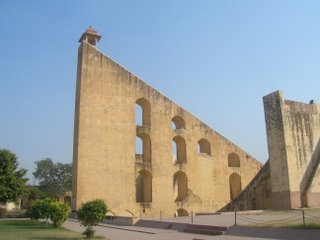
This picture is from one of my favorite places on the trip. Palaces and forts can get pretty boring after a while, so I really liked this outdoor observatory built by a Jaipur maharaja in the 1700s. It was almost like a sculpture park, filled with all sorts of kooky big instruments for telling time, the positions of the stars, and zodiac stuff. This was the highlight - a 90-foot sundial that still tells time suprisingly accurately. I believe it was only about 30 seconds off.


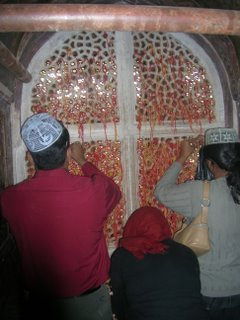
This is a photo from within a mosque at a monument called Fatehpur-Sikri which we visited en route to Agra. For about 10 rupees, you can buy a small piece of this sacred red and gold thread and tie it to the carved marble window, making a wish at the same time. You can't even see through it anymore at the bottom - it's completely choked with threads.

Next stop - the Taj Mahal!

North India trip

Hello everybody - I've just returned from a trip around North India and I have pictures galore for you all. First, we visited Rajasthan (the name literally means "land of kings"), a state bordering on Gujarat that is famous for its palaces and forts. It's also a land of camels, and with that in mind we went on a desert "safari", with everyone riding into the desert on camels and playing in the dunes. Here's me and my friend Sam on a camel named (I'm not making this up) Michael Jackson:


Note the coats - it was freezing! Hooray for cold! Because I'm a big fan of Rajasthani turbans - huge bulbous creations in neon colors - I snuck a picture of this guy through the window of the bus. (Hence the water bottle.)


In Jaisalmer, there are tons of old buildings like the one below. The area around the open windows is made up of intricately carved marble screens, so that people inside can see out, but no one outside can see in. This is due to the purdah system, which was prevalent in Rajasthan for hundreds of years and dictated that a woman could not be seen by any men but the ones in her family. In fact, when the queen of Jodhpur (a nearby city) visited England in the early 1900s, the British media went crazy trying to get a picture of her, as she was always completely covered in veils from head to toe. When a photographer snapped a picture of her bare ankle as she was getting down from a car, it made the front page. The outraged royal family immediately bought up every copy of the paper in the country.
The purdah system has been mostly abolished in Rajasthan, and is now seen only in villages. While we drove from city to city, we occasionally passed through small towns with women passing ghostlike through the streets, their faces covered in veils.

Sunday, December 17, 2006

Pictures pictures pictures...

Alrighty. Here are some of the latest pictures - unfortunately I couldn't take any of the Wara wedding as my batteries were dead, but we did attend another wedding later. This first picture is a roti that I myself actually rolled out. Note its (almost) roundness!! To give you an idea of what an accomplishment this is, it took me about two weeks of rolling out flower-shaped rotis or rotis with funny little protrusions from the side to finally get this one right. I'm quite proud of myself.


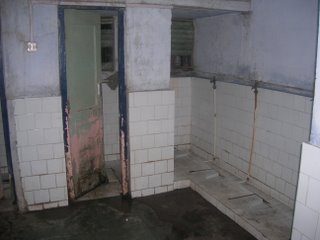
And take a look at this lovely school bathroom...this should give you an idea of what we have to deal with here. I actually didn't use this one, I only went in to change my clothes, but it was so raunchy I just had to take a picture to show you guys. FYI: the stalls contain identical toilets to the ones against the wall. I guess if you don't like the idea of squatting next to your neighbor, then you can use the stall.


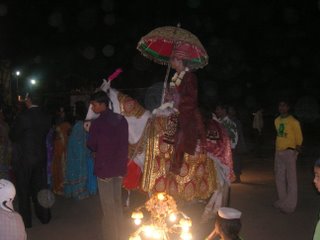
Now I don't know if you can even see this next picture clearly, but it is a picture of a groom on horseback, on the way to his wedding. It was quite a function - the wedding and reception were held on a plot the size of a football field, with thousands of guests. When Indians throw a party, they don't mess around.


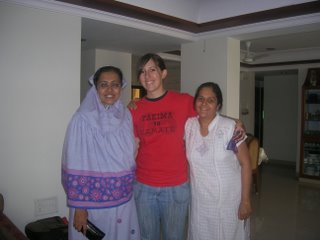
This next picture is me with my Wara host mom (she's on the left, wearing her rida) and my current host mom.


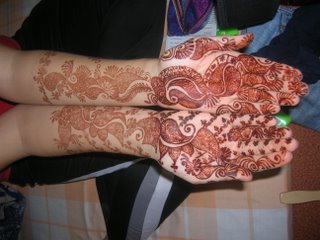
And lastly there's my beautiful wedding mehndi. At an Indian wedding, all the female guests get to apply mehndi to their hands. I love it! I'm taking classes soon, so I can give everyone cool henna tattoes when I go home.

Sunday, December 10, 2006

Jains and Moslems part II

For the last week, I've been staying with a Moslem family, just to experience their way of life. Moslems are the minority here in India - I believe they make up about 10% of the population of India. There has traditionally been a lot of enmity between Hindus and Moslems (mostly fueled by power-hungry government officials). I won't go into that her, but for more info, read up on Partition following India's independence from Britain. However, relations have been improving lately, and myself and Miho (another exchange student, from Japan) were invited to stay with the Lokhandwala family for a week to learn about their traditions and religion.
The Lokhandwalas are Wara, a particular sect of the Moslem religion. They are not as strict as Moslems in some respects, although the women are expected to wear a burqa-resembling dress called a rida whenever they go out. The rida actually looks kind of Amish to me - it is made up of a long skirt and cape-like top over the arms, with a hood that covers the hair so that only their faces are peeking out. Ridas are much more colorful than the black burqas other Moslem women in Surat wear, and they are often brightly colored and embroidered with flowers. Wara men generally wear a white and gold circular, flat-topped hat with a white tunic and pants. I personally like this look.
Waras eat sitting on the floor, surrounding a huge steel plate called a thal. Everybody gets their own rotis and takes food from the dishes in the center of the thal. Before and after eating, everyone takes a tiny pinch of salt, supposedly to prevent sickness. The food's delicious - they eat meat every day! It tastes great, although I got sick on the second day from eating so much meat all of a sudden.
Our host mother took Miho and I to see the Arabic University in Surat's Old City a few days ago. It's a beautiful school for Wara students, and all of the classes are taught in Arabic. My favorite part was the building used for students who are memorizing the Quran - this is required for graduation, and it's no small task, considering that the book is almost 700 pages long. In order to create a peaceful atmosphere with as few distractions as possible, they have practically soundproofed the building and made it into a sort of greenhouse. There are plants and flowers everywhere, surrounding a tile pool in the center. If they wish, the students can use individual rooms looking out over this view. Every school should have a building like this.
Girls also attend the University (they're required to wear ridas), but a lot of effort is used in keeping them completely seperate from the boys. Whenever they have classes together, a curtain is kept between the girls and boys side, and if a male teacher is teaching a class of girl students, a veil is drawn between him and the girls, to prevent him seeing his students. There are even seperate floors for boys and girls in the school mosque and cafeteria. I actually think it's rather sad - I have so many good friends who are boys, and my life would be a lot less interesting without them.
But anyway, our host family also took us to a Wara wedding that took place this week. It was so cool - I love Indian weddings! They take place over three days, and are the glitziest, most extravagent events ever. On Friday, I went to the groom's house for a ceremony where some aunties grind up spices like turmeric and cloves to smear over the groom's face (don't ask, I have no idea why, the groom didn't even know when I asked him). While they're grinding away, the rest of the guests try to distract them by throwing silly string, confetti, spraying shaving cream, and all sorts of gooey, stinky, sticky substances. Eventually this turns into a free-for-all, which everyone covered in gunk by the end. I personally ended up with a lot of egg and ketchup on my shirt and in my hair. Every wedding should contain a good food fight.
After everyone went home and bathed, we regrouped for lunch and applying wedding mehndi. I got my arms covered in a beautiful swirly design, pictures of which will be posted here...eventually. The next day, we met again for a dinner following the actual wedding ceremony (which only close family members are allowed to attend, unfortunately). Miho and I dressed up in Indian clothes, and had to keep our heads covered at all times with our dupattas - Indian-style scarves. This is a lot more difficult than it sounds. My dupatta had an entirely different agenda, one which certainly didn't include staying put on my head.
Yesterday, we attended the final function of the wedding, a parade through the streets with a band and the groom on horseback, completely covered in a cape of flowers. All of the men in the groom's party get to walk alongside him. Four of the youngest boys get to lead the parade, riding atop their own horses, followed by three tiny girls perched in horse-drawn carriages. The groom brings up the rear. We watched them go by with the rest of the women, cheering away. This was followed by yet another dinner, and then we left, happy and stuffed with good food.
Miho and I are returning to our respective host families today, and life will get back to normal. On January first, we're leaving for a tour of North India, which is going to include the Taj Mahal! I'm so excited! Thanks for reading, everybody, and I hope all this makes up for last month's lack of posts!

Jains and Moslems

...Oh yeah, I have a blog. Sorry everybody for the really long break, but we've been having computer issues. The computer at my new host house has gone AWOL, and my host father's been saying he'll buy a new one, but as promptness is not part of the Indian vocabulary, that probably won't take place in this century.
So anyway. I've just switched host families, and this is my new address:
Paresh Shah
3B, Ravi Chhaya
nr. Lourdes Convent School
Athwa Lines
Surat, 395007
My new family is Jain (pronounced "Jane"), which is a religion similar to Buddhism - but with much more emphasis on self-denial - that's quite popular here in Gujarat. In fact, the reason that Gujarat is predominantly vegetarian is thanks to the influence of the Jains, who don't believe in killing any living creature. Jain monks walk barefoot and tie a piece of cloth over their mouth in order to avoid accidentally inhaling any small insect that may want to fly in. In fact, strict Jains won't even eat potatoes, garlic or onions, and I have heard two explanations for this:
a) harvesting any of the above involves killing the plant that grows above it, or
b) they believe that these vegetables contain countless little lifeforms, and eating one would practically constitute genocide
Fortunately, my host mom is the only member of the family who believes this, and prepares potato, garlic and onion-containing food for her husband, my host sister Kanika, and myself. She's actually a great cook, which is impressive, considering her limited array of ingredients. I find that I'm missing meat less and less. (That doesn't mean that I don't appreciate the beef jerky you sent me though, Taylor.)
Kanika and her aunt have taken me several times to a house where Jain holy women live, and these women are seriously amazing (or crazy, I haven't decided yet). They basically live their lives with a view to hurting the least lives possible, and sometimes take this to extreme levels. As they believe that electricity kills small creatures, they live without it, without even fans to cool them off in the boiling summer months. They own very few possesions - usually only what fits into the small bag they carry with them - and the furniture is very minimal, only a few wooden bedframes. Bathing takes place as rarely as possible (usually twice a year at most), due to the belief that water also contains millions of small creatures, which is also the reason that they never brush their teeth. They pluck out their hair every six months - minus scissors, this is done by hand - to avoid getting lice, as they bathe so rarely. If the women wish to travel, they walk (barefoot, of course), as trains and cars are practically small-insect serial killers. They spend their days studying holy books, praying, or simply saying the name of god over and over again. They eat only when the sun is out (actually, I'm not sure of the reason behind this) and go from home to home begging food. If no one gives them food, they take it as a sign that god did not want them to eat that day anyway.
Some of these women converted later in life, following their schooling, so I got a chance to talk to some who had studied English in school. They are really truly happy with their lives, and don't miss the outside world one bit. I think some of the things they do are rather impressive, though I can't quite relate to the whole hair-pulling-out thing.
Ok, this is getting quite lengthy, so I'll save part II for the next post...

Friday, October 27, 2006

I take cool pictures

A couple of other pictures from our trip:
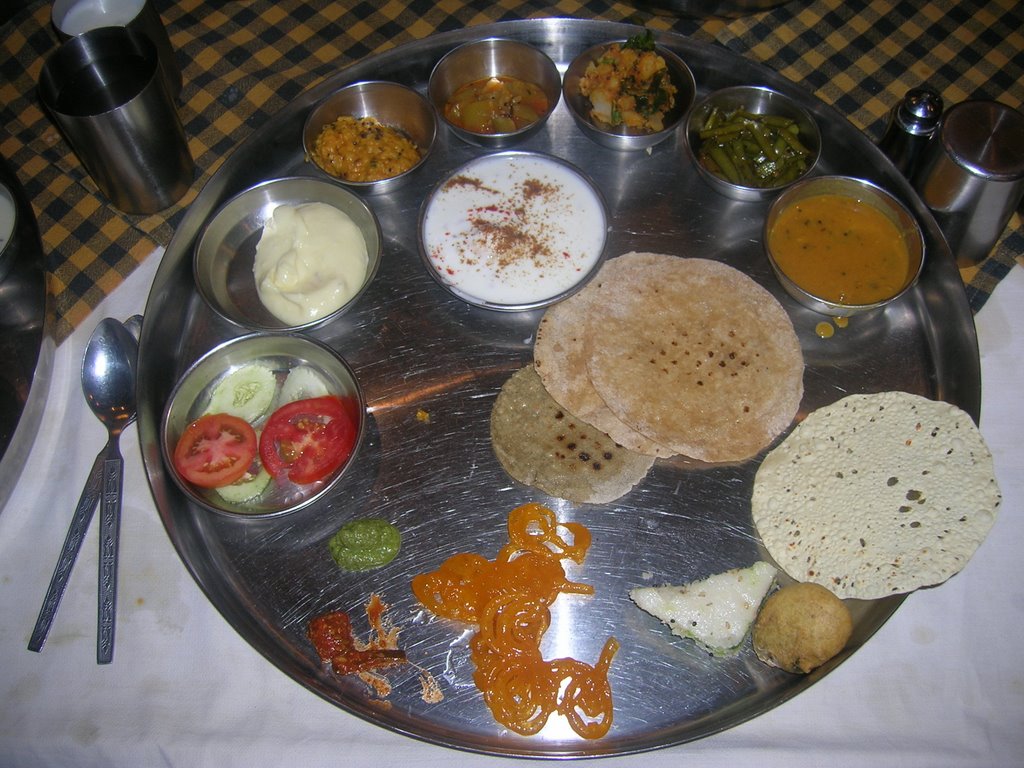
We went to a restaurant serving a traditional Gujarati thali, and I had to take a picture of the food, it was just so pretty. This should give you an idea of what I eat here (though as a rule, home-cooked food is always better than restaurant food in India). We use the roti - that flat, tortilla-ish thing - instead of silverware. Basically you tear off a piece and use it to grab a bite of food.


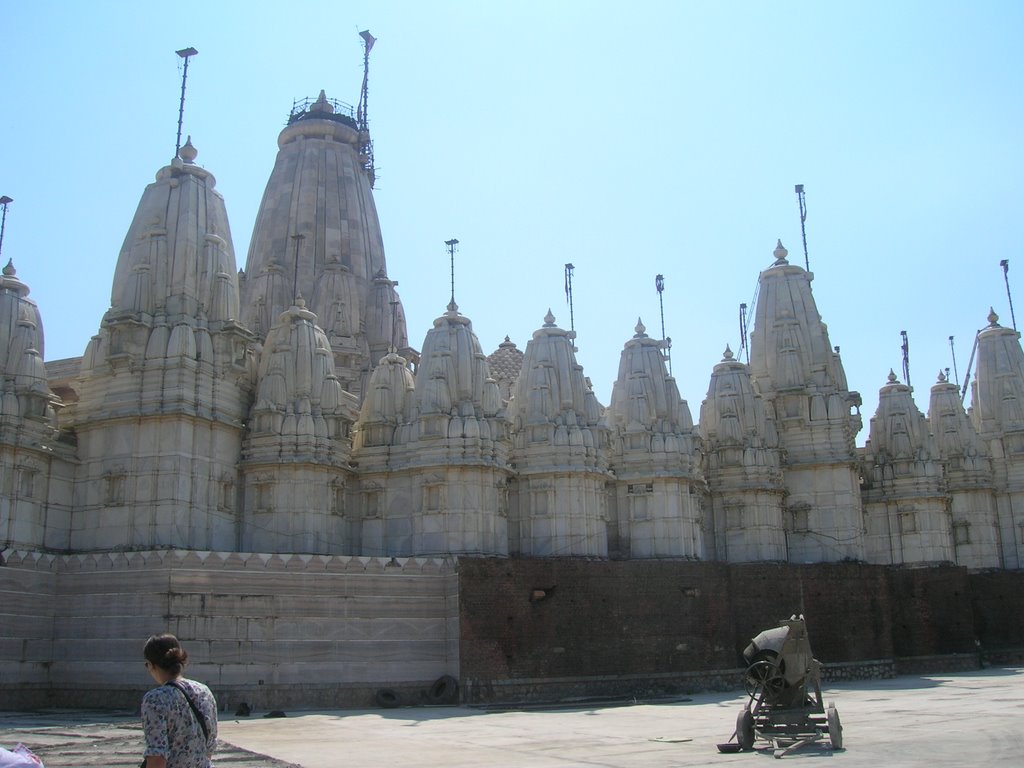
These women are selling spices at the base of a temple we visited, which you have to climb 10,000 stairs to reach. We wimpy exchange students went up 100 stairs, took some pictures and went back down for coconuts and ice cream.

Thursday, October 26, 2006

Indian Toilet Odyssey Pt. 2

Ah, India. Just when I thought squatter toilets and hand-wiping was as bad as it gets, something else comes up to prove me utterly wrong. Try this: a little room the size of a shower stall. Tile floor. A drain in the corner. Nothing else. The first time I was confronted with one of these lovelies, I thought I'd gone to the wrong place. This couldn't be the bathroom. Then I realized what I was standing in, and turned and marched right out of there, using all my self-control not to run away screaming. I don't know how Indians do it! I would gladly take an American gas station bathroom right now. That's nothing to this.
My latest toilet adventure took place on our recent tour of Gujarat. We stopped at a town called Rajkot, and were taken to a movie theatre owned by a Rotarian. I went to use the bathroom, which naturally had no toilet paper, no soap, no towels, etc. I was unfazed by this, as I now carry my trusty little toilet paper roll with me wherever I go. However, I was completely unprepared for the BIG HUMONGOUS GIGANTIC cockroach that came scuttling down from beneath the rim of the toilet seat when I flushed. Aaaaaah! It was the size of my middle finger (at least), bright red-brown, and had just been lurking there the whole time. Fortunately I have mastered the art of hovering. My self-control failed me this time, unfortunately, and I ran right out of there as fast as I could. Blecchh.
Other than the traumatizing toilet experiences, our tour was a lot of fun. I got to see Gandhi's birthplace! So cool...We visited his home in a town called Porbander. The exact spot where he was born was marked on the floor by a giant red swastika (a word on the swastika: It has been a symbol of the Hindu religion, something like the cross or star of David, for thousands of years, long before Hitler corrupted it for his own purposes. They are still to be found all over India, and most Indians are unaware that it is a symbol of hatred and prejudice in the west).
We exchange students are all officially temple-d out, but one in particular was interesting, as it featured a pillar built very close to the wall. It is believed (they weren't very clear as to why) that if you can squeeze through this narrow space between the pillar and wall, your heart is pure and you're guaranteed a place in heaven. You wouldn't believe the contortions and sucking in of stomachs that goes on as people try to force their way through. I now have a spot reserved for me in Hindu Heaven, because I made it through! Here are pictures of some other temples we visited:

Tuesday, October 24, 2006

Navratri Pictures...finally


Oops, once again it's been awhile since I last posted, but they say a picture's worth a thousand words, so hopefully this will make up for it!
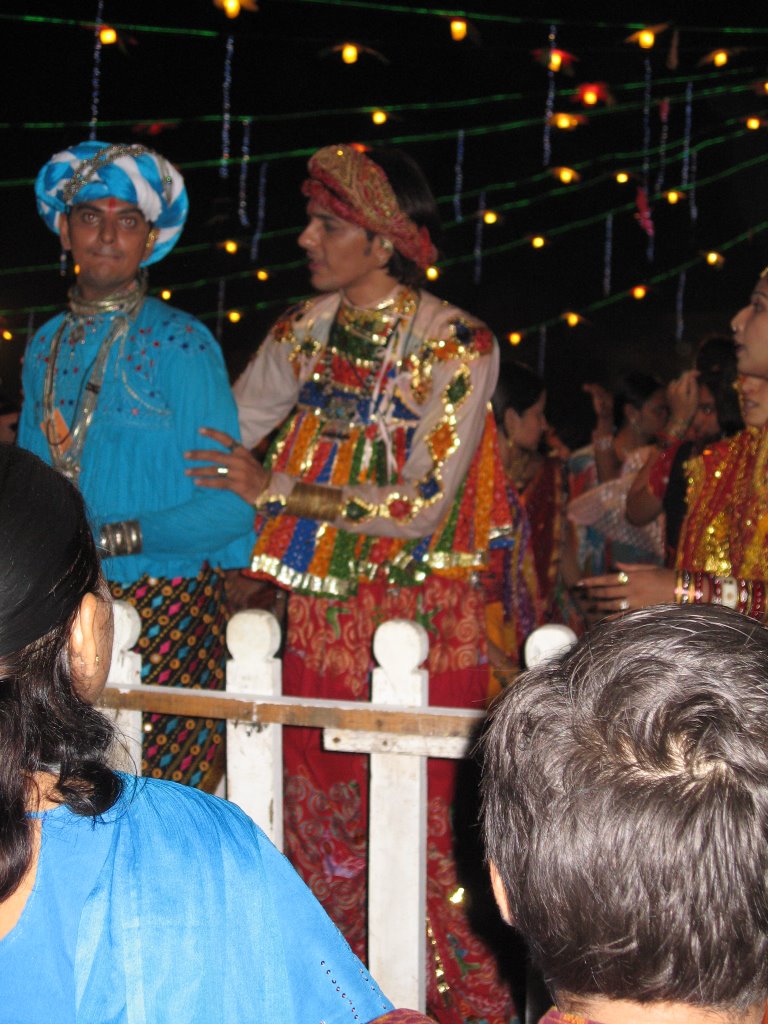
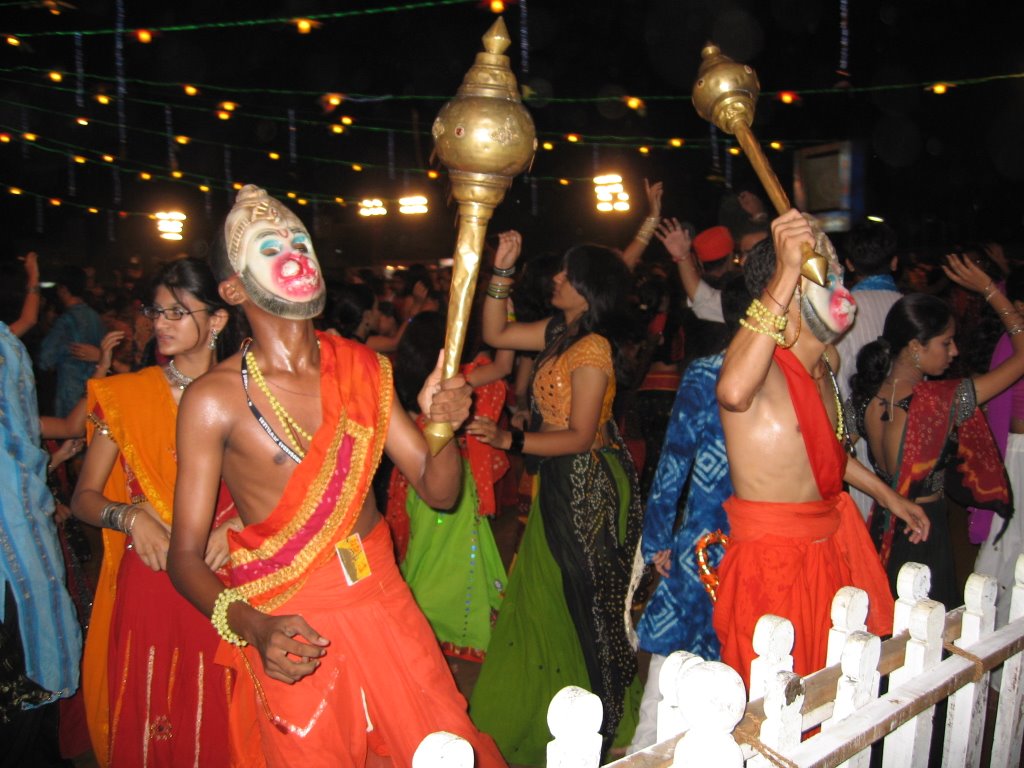
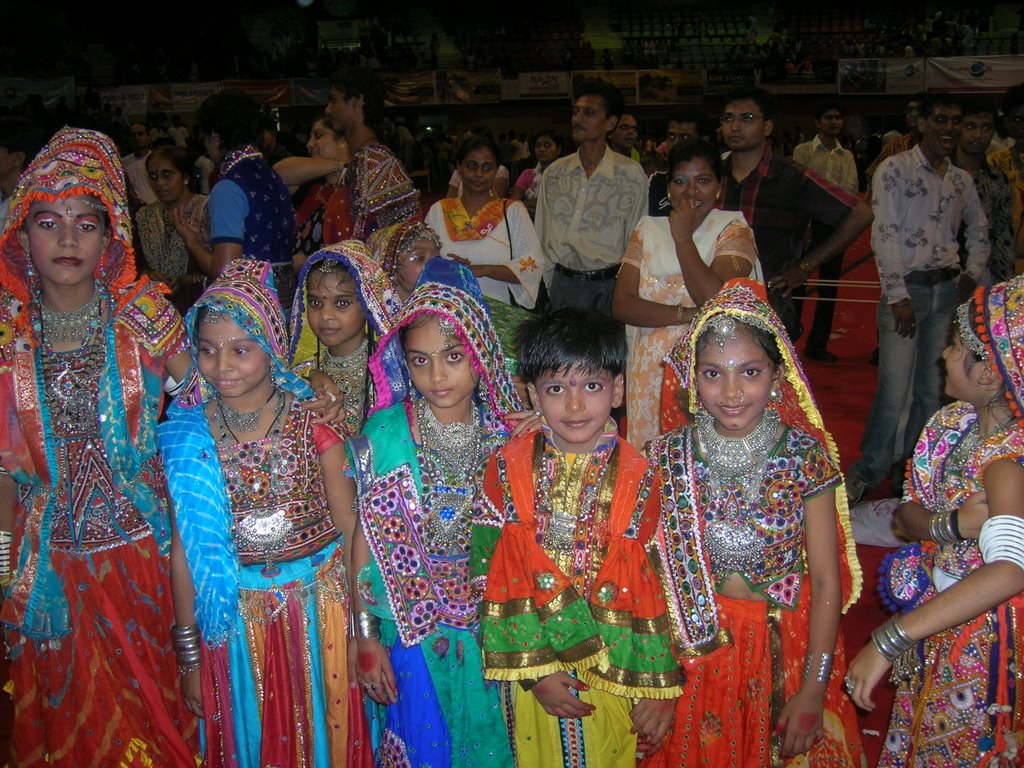
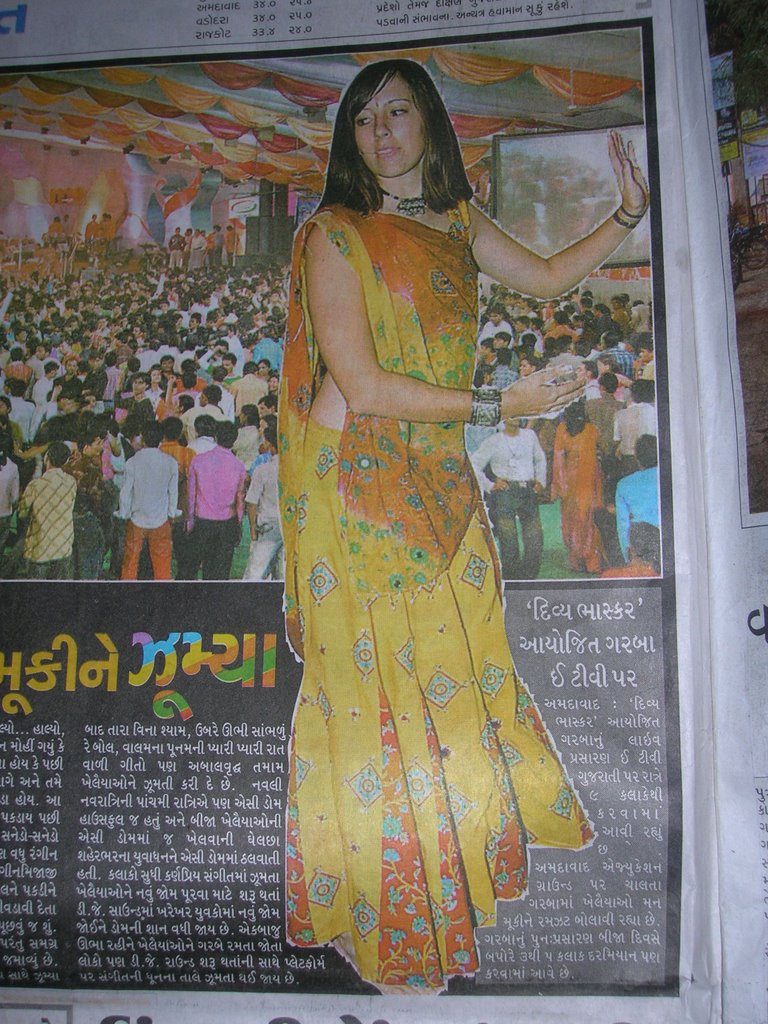
The first picture is a woman dancing with pots on her head, which is quite a big deal here. Then a couple of guys in traditional dress, which I personally think is rather goofy. The next one is two guys dressed as Hanuman, the monkey god. He's my favorite Hindu god, mostly because I can make a face that looks exactly like him. Then some kids decked out in their Navratri finest - aren't they cute? And because Indians are delighted that a foreigner has learned their dances, a huge picture of me appeared in the newspaper - too bad I was mad at the photographer, who wouldn't leave me alone, and therefore have a wierd look on my face. And lastly, me and my sisters, all ready to go out and dance the night away. For some reason, Indians rarely smile in pictures.

Sunday, October 01, 2006

Navratri = love

Ahhh I have just experienced the best nine days (well, nights) of my LIFE! Navratri is the most amazing thing in the world and every country should have it. I am so bummed that it's over. I'm starting to discover the depressing side of the saying Once in a Lifetime Experience - when will I ever get to do something like this again?
Anyway. Every night, after dinner (around 8ish) my three sisters and I would all start getting ready, donning our chania cholis, dupattas (tied around the shoulders/waist so my glaringly white tummy isn't quite so obvious), makeup and lots of jewelry (necklace, jingly waist belt thing, anklets, bangles, and extremely heavy swinging earrings that I refused to wear - I swear Indian earlobes are stronger than my wimpy American ones), until we can barely walk. All this takes about an hour and a half, and meanwhile, Rutvik is sitting downstairs in an undershirt, watching TV. Five minutes before we leave, he throws on a shirt and dupatta and is ready to go. Boys. Honestly. At 10, we set off for the Indoor Stadium, which is kind of like the Sundome (for all you Yakima folks), but approximately 5 times bigger, and packed with at least 4,000 people every night. From here, I'm going to just copy what I wrote in my journal after the first night, since I think that describes it best:
Sept. 24, 2006 2:30 AM
Back from the Indoor Stadium. The soles of my feet hurt. My calves are sore. I've been poked, elbowed, kicked, smacked, hit with a garba stick, shoved, and even headbutted. All of this accidently (at least, I hope so), and I've doled out my fair share of punches and kicks as well. It's inevitable when you're dancing so fast, with so many people around. I have a monster bump/bruise above my left elbow. And I LOVE it!! There were tons of people there, and Pooja said there will be more and more as the days go by. Inside, the floor is divided, with one side for people in traditional dress who play garba, and the other for people in Western dress who just dance normally as there's no room to make a circle for garba. We'll be on the traditional side every night. I like traditional because there's more room and none of that awkward shifting from foot to foot and avoiding eye contact that passes for dancing on the Western side.
We got there at about 11, in the middle of a "song" (they're actually a bunch of songs with no pause in between, gradually going faster and faster). We joined a circle of people doing a couple's 22-step - women on the outside, men in yellow kurtas and white dupattas on the inside. At one point in the step, instead of clapping our hands twice like normal, we clap twice quickly, and then clap the hands of a guy inside the circle. It was great - we jumped right in, and I only took a couple of little breaks in the hour-long song, during which I sweated a ridiculous amount and my face turned bright red. Well, I didn't have a mirror to check on this or anything, but I saw by the end of the song, Pooja's cheeks had gotten slightly red, and when the Indians are getting red, you can be sure that I'm a tomato. There were lots of photographers and judges roaming about, and a bunch of people took pictures of me. I might be in the paper tomorrow!
After the song, they started playing Indian pop music (which is starting to grow on me) for about a half hour. When that was finished, they kicked off the final garba, which got really fast after only 5 or 10 minutes. I love dancing garba fast - everyone's skirts twirl out, all the mirrorwork and sequins on skirts and blouses catches the light, and hands whip about at lightning speed. When it was done, and we were all laying around panting, they announced the winners for Best Dancer, Best Dressed, etc and we went home to drink gallons of water and cold cocoa. Eight more nights of this. Hooray!

Alrighty. So nine nights and five big blisters on my feet later, Navratri's over. Here are the highlights:
1) I have been in the paper 3 times - the first was my name in the Times of India, mispelled and attributed to a picture that, unfortunately, wasn't me. The next two were in Gujarati newspapers, and one was ridiculously, embarrassingly huge, especially as I looked really serious.
2) I've been on 2 seperate news channels, once being interviewed personally, and the other while singing a dreadful rendition of a traditional Gujarati garba with the other exchange students.
3) I won a prize! Probably just for being a foreigner, but oh well. It was the "Special Prize", and my reward was three saris, which I have no idea what to do with. Anybody want a (slightly lower-quality) sari?
4) I've only gone to school twice during the nine days, a result of coming home pooped at two every morning.
And so much more, but this is already ridiculously long, so I'll spare you the rest. For all of you with the stamina to read the whole thing, kudos to you. Navratri pictures are coming soon, I promise!

Some random pictures...


Just a few uncategorize-able pictures for you all...mehndi (it got a lot darker, this was taken on the first day), my school (how's this for a name - Bhartiya Vidya Bhavan's Nand Vidya Niketan), annnd me in a sari!

Friday, September 29, 2006

Post-flood pictures


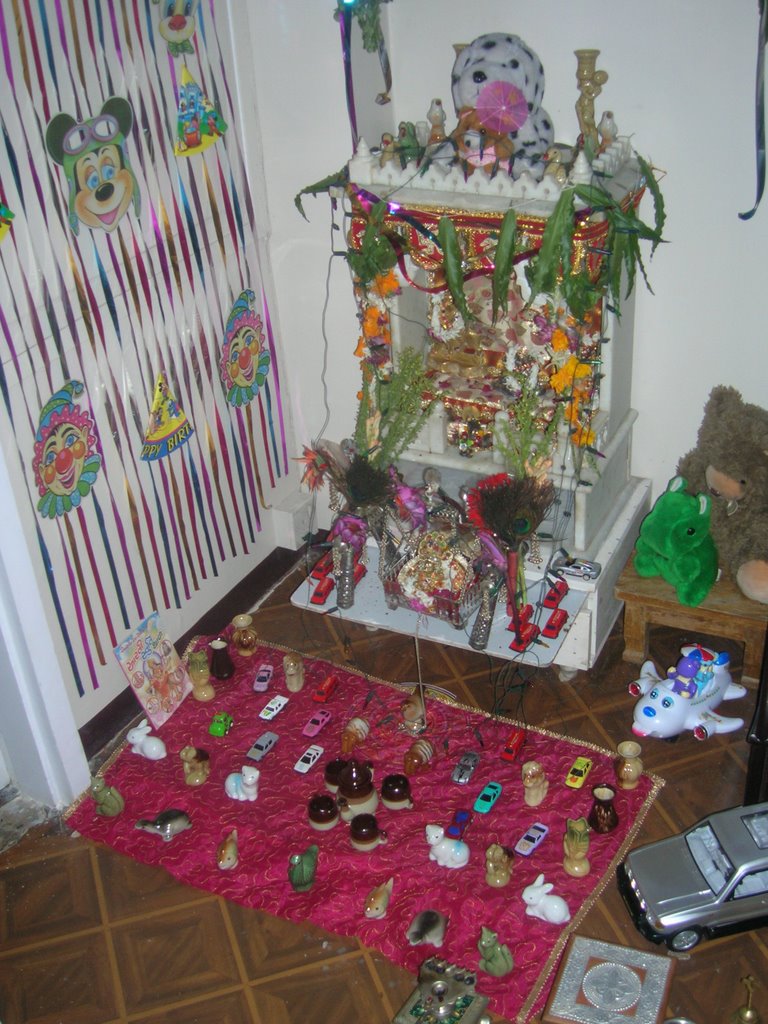
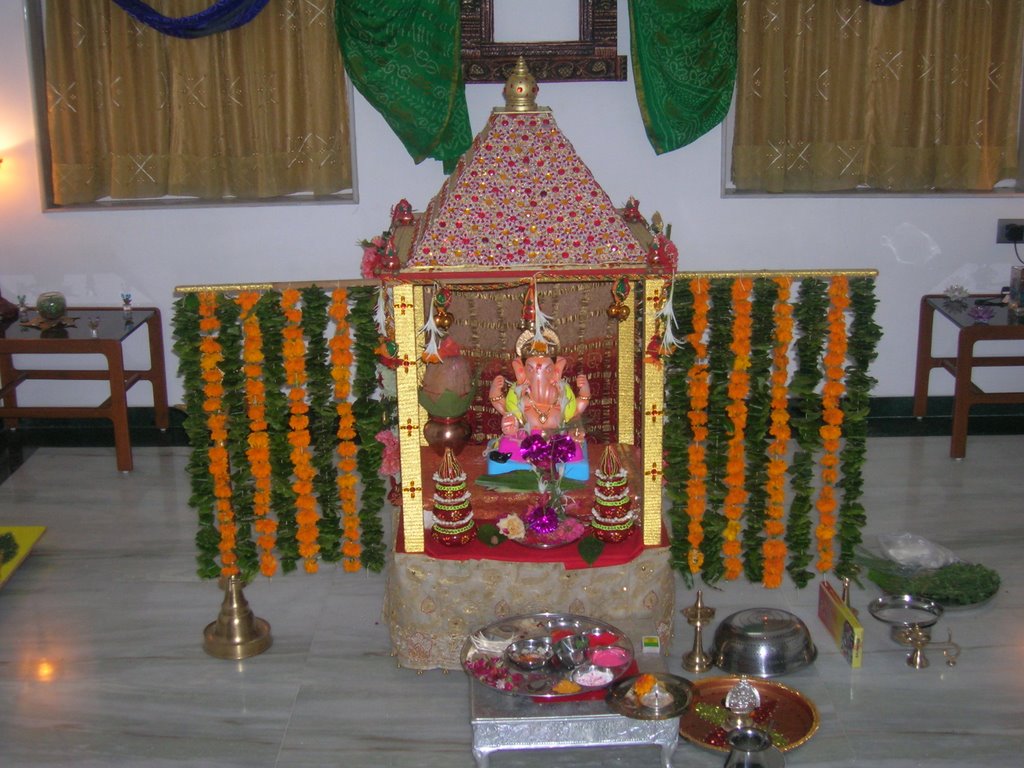
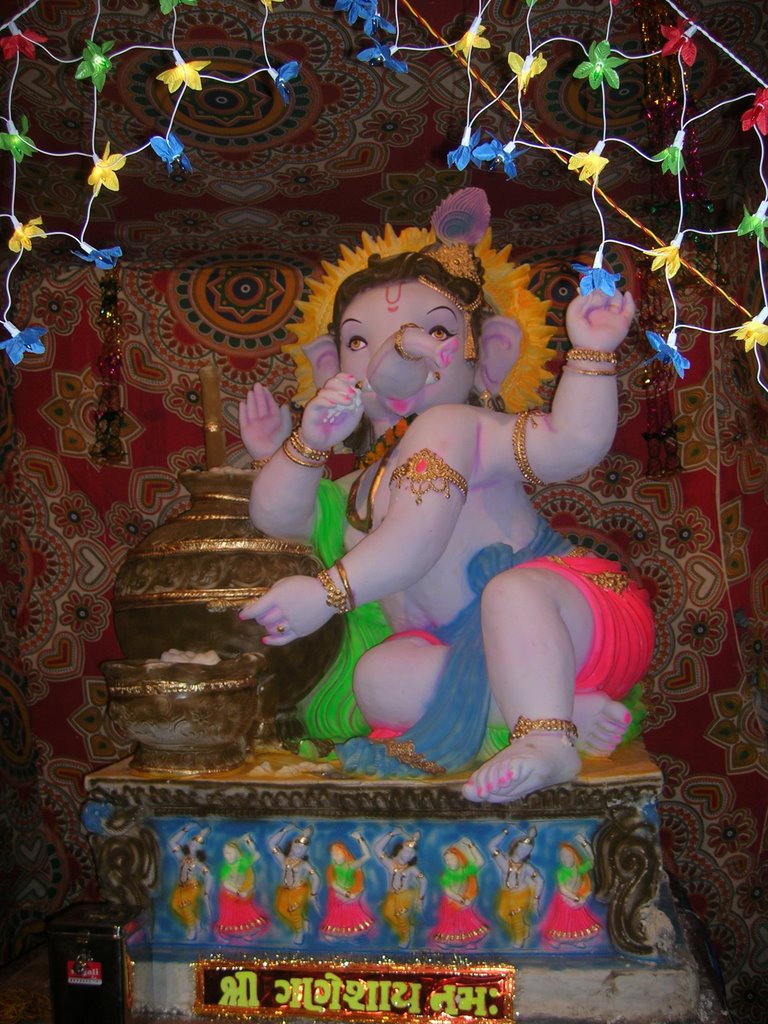
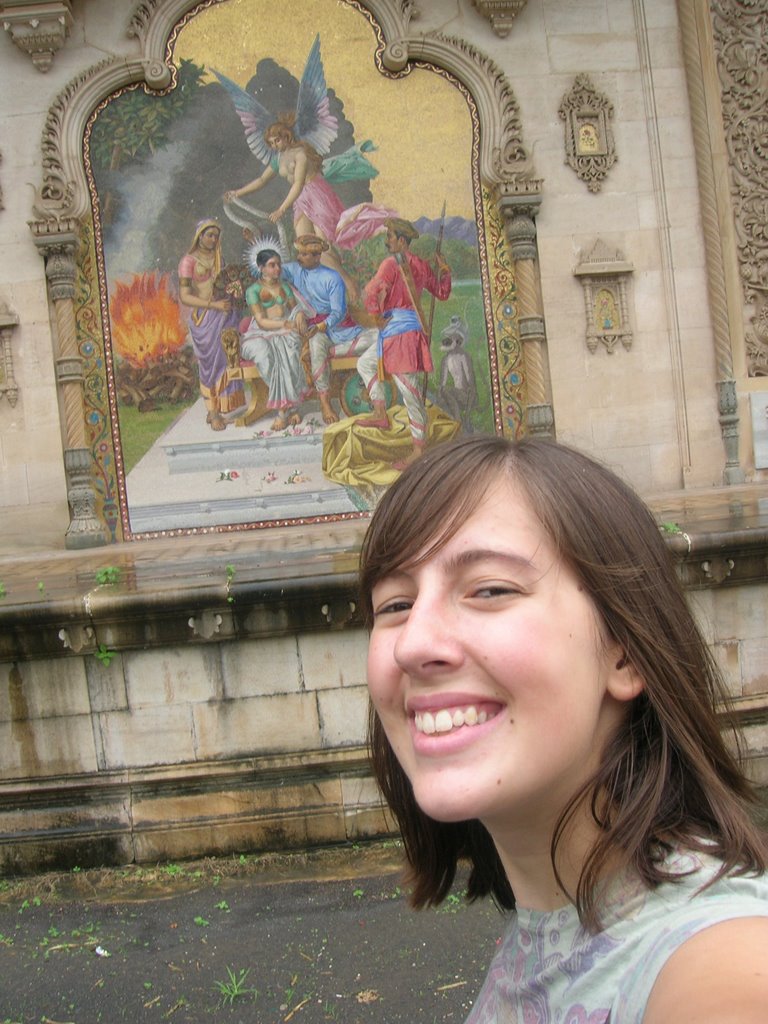
Alrighty, these pictures are from the time right after the flood, when we stayed in the Old City and when I went to Baroda. First of all is our Janmastame shrine from the Old City - note the model cars and Disney masks. Then our Ganesh Utsav shrine from the house I stayed at in Baroda (I personally like the last one better). During this festival, huge shrines are set up all around town with monster Ganesh idols in them. Samantha (another exchange student from the US) and I walked around town for awhile checking out some shrines, and here's a picture of a gigantic Ganesh. Later on in Baroda, we visited the Laxmi Vilas palace - which the current maharaja still lives in! It was amazingly huge, and it seemed like everything was covered in gold. For some reason, our tour guide made a really big deal out of the Italian marble on the floors. Indians love their Italian marble, I've discovered. And finally, a not-so-flattering self-portrait in front of a lovely mosaic on the side of the palace. Enjoy!